Logical scholarship in the medieval Arabic-speaking world involved translation, interpretation, criticism, and the construction of new systems. Its history extends far beyond the preservation of Greek texts for later European readers.
The labels in this title overlap without being interchangeable. Arabic was a language of scholarship used by Muslim, Christian, and Jewish authors. Islamic intellectual settings included many languages and communities. Jewish logical writing circulated through Arabic, Hebrew, and later Latin contexts.
The appropriate unit of explanation is therefore a particular author, text, school, or documented route of transmission.
Translation as intellectual work
Greek philosophical and scientific texts entered Arabic through a substantial translation movement, particularly in the eighth through tenth centuries. Syriac scholarship supplied important intermediaries, although the routes were not always a simple single chain.
Ḥunayn ibn Isḥāq, Isḥāq ibn Ḥunayn, and other translators worked within networks of patrons, physicians, philosophers, and scholars. The Baghdad Aristotelian tradition included Christian thinkers such as Abū Bishr Mattā ibn Yūnus and Yaḥyā ibn ʿAdī.
Translation required choices about technical vocabulary and relationships between grammatical and logical form. A term for predication or demonstration had to work within a new scholarly language.
The resulting logical culture developed its own debates about the relation of logic to grammar, philosophy, theology, and other disciplines. The historical account of language and logic in Arabic and Islamic philosophy provides an entry into these questions.
Al-Fārābī and the organization of logic
Al-Fārābī, who died in 950, developed an extensive account of logic and its place among the sciences.

Sources and credit for Al-Fārābī
Mr.Nostalgic. Via Wikimedia Commons. Image source · Public domain · Biographical dates
His project included the relationship between language and thought, the forms of syllogism, and the difference between kinds of argument. Demonstration, dialectic, rhetoric, and poetry could be studied within a broader logical organization associated with the expanded Aristotelian curriculum.
The contrast among these forms concerns their purposes and the status of their premises. An argument designed to persuade an audience is not assessed in exactly the same way as a demonstration intended to yield scientific knowledge.
This broad conception helps explain why historical logical texts include subjects that a contemporary mathematical-logic textbook might assign to epistemology or rhetoric.
Conception and assent
A durable distinction separates the acquisition of a conception from assent to a proposition.
Understanding what a triangle is differs from judging that every triangle has a certain property. Definitions contribute to conceptual understanding; arguments contribute to warranted assent.
The distinction organizes questions about how knowledge is acquired. A definition can fail to identify the intended object even if a subsequent argument is formally valid. An assertion can lack justification even when its terms are understood.
Later authors refined these categories in different ways. They should be treated as part of a historical theory of knowledge and reasoning, rather than forced into an exact equivalence with modern syntax and semantics.
Ibn Sīnā's independent logical project
Ibn Sīnā, known in Latin as Avicenna, lived from 980 to 1037. His logical writings, including the logical sections of The Healing, reorganized and extended the inherited subject.
.jpg)
Sources and credit for Ibn Sīnā (Avicenna)
National Library of Medicine. Via Wikimedia Commons. Image source · No restrictions · Biographical dates
His treatments of propositions, modality, temporal qualification, hypothetical reasoning, and demonstration became central to later scholarship.
The history is not adequately described as a commentary on Aristotle with a few additions. Avicennan logic supplied a framework that subsequent thinkers developed, criticized, and taught through an extensive post-Avicennan tradition.
The specialist account of Ibn Sīnā's logic distinguishes the projects within his works and explains why their interpretation requires attention to his own terminology.
Why temporal qualification matters
Consider the claim “Every writer is moving.”
Does it concern everyone who is writing at the present moment? Everyone who has ever been a writer? Does the movement hold while the person is writing, throughout the person's existence, or at some unspecified time?
A person's remaining human while ceasing to write makes the distinction important. Predication tied to a temporary description cannot automatically be extended to every time in that person's life.
As a modern explanatory reconstruction, compare
with
The first says that movement accompanies writing. The second says that anyone who ever writes is always moving. The first does not entail the second.
This example is not offered as a transcription of an Avicennan formula. It illustrates why his distinctions about the subject's description and the time or modality of predication affect syllogistic inference.
A valid restricted inference
Suppose we have two appropriately synchronized claims: every person who is writing is moving at that time, and every person moving at a time is undergoing a change at that time.
Then the conclusion that every writer is undergoing a change while writing follows by connecting the predicates at the same time.
If the second premise instead said that every moving person is at some time undergoing a change, the conclusion's temporal strength would differ.
The logical problem is therefore not merely which term appears in which premise. One must track the qualifications attached to the predication.
Historical modal syllogistics develop such distinctions in their own formal vocabulary. Modern reconstructions are useful when they expose the issue without pretending that the original authors used the same semantics.
Ibn Rushd and competing inheritances
Ibn Rushd, known as Averroes, lived from 1126 to 1198. His commentaries pursued a distinctive interpretation of Aristotle and engaged with alternative developments in the philosophical tradition.

Sources and credit for Ibn Rushd (Averroes)
Sailko. Via Wikimedia Commons. Image source · CC BY 3.0 · Biographical dates
His reception in Hebrew and Latin made him particularly important in some later settings. Avicenna's influence was especially strong within much subsequent Arabic logical scholarship.
These differences prevent a simple story in which one author replaces another everywhere. Textual availability, educational institutions, and philosophical commitments shaped which works became authoritative.
Post-Avicennan logic
Fakhr al-Dīn al-Rāzī, Naṣīr al-Dīn al-Ṭūsī, Afḍal al-Dīn al-Khūnajī, and Najm al-Dīn al-Kātibī contributed to the continuing development and reorganization of logic.

Sources and credit for Nasir al-Din al-Tusi
Creator not identified in the source record. Via Wikimedia Commons. Image source · Public domain · Biographical dates
Al-Kātibī's Shamsiyya, written in the thirteenth century, became an influential teaching text with a long commentary tradition. Later scholars debated definitions, propositions, syllogisms, and modal relationships through such curricula.
The survival of a teaching format does not imply the absence of intellectual change. Commentary, supercommentary, and disputation could be vehicles for precise disagreements.
A history ending this tradition with Avicenna or Averroes would omit centuries of scholarship and the institutions through which logic continued to be studied.
Jewish authors and several languages
Maimonides, who lived from 1138 to 1204, wrote philosophical works in Judeo-Arabic. A short logical treatise traditionally attributed to him became influential, although its authorship has been questioned in modern scholarship.
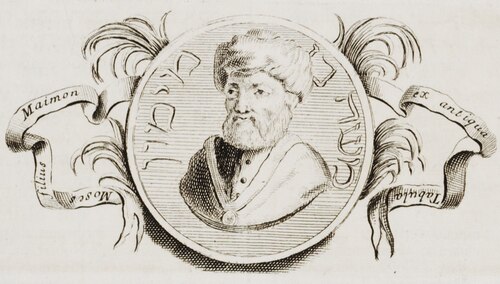
Sources and credit for Maimonides
Blaisio Ugolino. Via Wikimedia Commons. Image source · Public domain · Biographical dates
That attribution should be marked rather than treated as certain. His wider engagement with demonstration and philosophical reasoning is documented independently.
Hebrew translators and scholars, including members of the Ibn Tibbon family, helped circulate Arabic philosophical works. Gersonides later contributed to logical analysis and syllogistic theory in a different setting.
Jewish thinkers participated in and transformed these intellectual networks. Their role should not be reduced to serving as a bridge between two supposedly self-contained civilizations.
Latin reception and its limits
Arabic philosophical works and commentaries influenced medieval Latin discussions through identifiable translations and teaching traditions.
The extent of the influence varied by author and topic. Latin access to Avicenna's logical corpus was partial, while Averroes's commentaries had their own substantial reception.
The survey of Arabic and Islamic influence on the Latin West documents these routes and their limits. Neither “no influence” nor “all later developments came from this source” is an adequate generalization.
The next companion examines the Latin traditions in their own right, including theories of reference, consequence, and semantic paradox.
Sources and further reading
- Al-Fārābī, logical writings and Enumeration of the Sciences.
- Ibn Sīnā, logical sections of The Healing, especially the works on interpretation, syllogism, and demonstration.
- Ibn Rushd, commentaries on Aristotle's logical works.
- Najm al-Dīn al-Kātibī, al-Risāla al-Shamsiyya.
- Ibn Sīnā's Logic, Language and Logic in Arabic and Islamic Philosophy, and Influence on the Latin West, Stanford Encyclopedia of Philosophy.
- Deborah L. Black, Logic and Aristotle's Rhetoric and Poetics in Medieval Arabic Philosophy (1990); Tony Street, “Arabic Logic,” in Handbook of the History of Logic, volume I (2004).